Australian Family History Templates
Free printable templates designed specifically for Australian genealogy research. A4 format, no account or sign-up required.
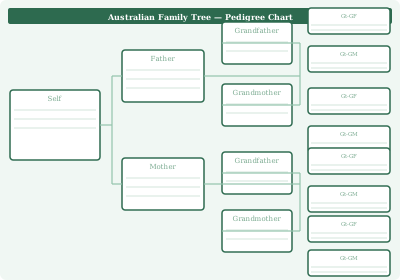
Australian Pedigree Chart
A 4-generation ancestor chart with State/Territory fields and Australian research tips. The standard format used by Australian genealogists. Landscape A4.
Free Printable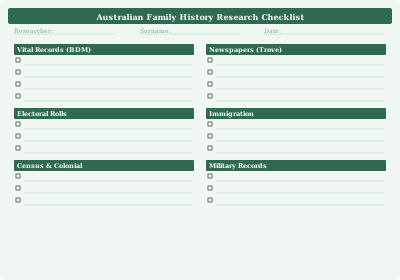
Australian Family History Research Checklist
Tick off every major Australian record source as you search — BDM registries, Trove, National Archives, electoral rolls, military records, and more. Portrait A4.
Free Printable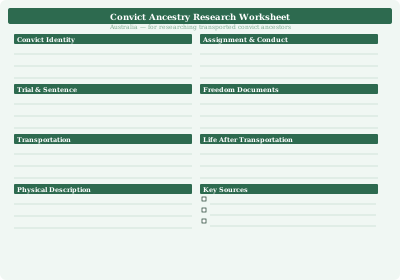
Convict Ancestry Worksheet
A detailed research worksheet for transported convict ancestors — trial details, ship name, indent records, assignment, freedom documents, and key Australian sources. Portrait A4.
Free PrintableAlso Useful for Australian Research
These general genealogy templates are equally valuable for Australian family history research.
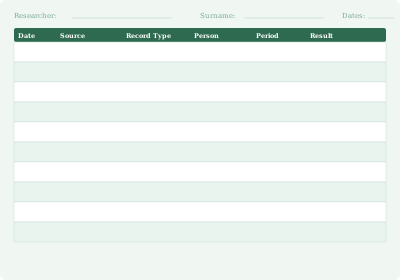
Genealogy Research Log
Track every source you search — Trove, BDM registries, NAA, FamilySearch — and what you found. Prevents duplicate searching. 18 rows per sheet. Portrait A4.
Free Printable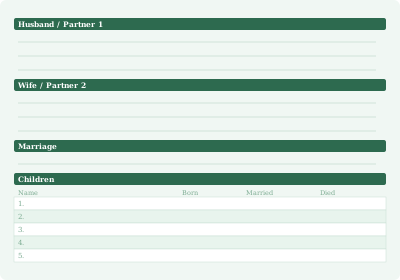
Family Group Sheet
Record one family unit — couple and up to 8 children — with full names, dates, places, and source references. Used by genealogists worldwide. Portrait A4.
Free Printable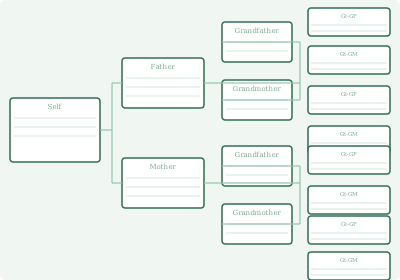
4-Generation Pedigree Chart
The standard genealogy ancestor chart — four generations of direct-line ancestors on one A4 landscape sheet. If you need Australian-specific fields, use the Australian Pedigree Chart above.
Free PrintableAbout Australian Genealogy Research
Australian family history research has unique characteristics that make it both challenging and rewarding. Civil registration of births, deaths and marriages began in the 1850s–1860s across the colonies, and records are held at the state and territory level rather than centrally. Unlike the UK or US, there is no single national civil registration repository — each state's BDM registry holds its own records independently.
Australia also has a significant convict heritage. Between 1788 and 1868, approximately 160,000 men and women were transported to Australia. A large proportion of Australians with early settler ancestors — particularly in New South Wales, Van Diemen's Land (Tasmania), and Western Australia — will find that one or more ancestors arrived as a convict. Specific record sets exist for this population that have no equivalent elsewhere: indent registers, conduct books, assignment records, muster rolls, ticket-of-leave files, and certificate of freedom records.
Trove (National Library of Australia) is the most powerful uniquely-Australian genealogy resource. It digitises historical newspapers from across Australia, making it possible to find birth notices, marriage announcements, death notices, funeral reports, court records, business records, and more for ancestors who lived before 1954. There is no equivalent resource in any other country at this scale.
Key Australian Genealogy Sources
- State and Territory BDM Registries — Each state holds its own birth, death, and marriage records. Most now offer online indexes and certificate ordering. Historical records (typically pre-1906 for NSW, pre-1899 for Victoria) are available through indexes like BDMHistory.
- Trove (trove.nla.gov.au) — Digitised historical newspapers with millions of searchable articles. Essential for finding birth/marriage/death notices, court proceedings, and local news about ancestors.
- National Archives of Australia (naa.gov.au) — Commonwealth records from 1901 onwards. Includes naturalisation records, WWII service records, immigration files, and pension records.
- State Archives — Each state holds colonial-era records: land grants, pastoral licences, colonial court records, insolvent estates, school admission registers. Most are available through their respective state archive portals.
- FamilySearch (familysearch.org) — Free global genealogy database with significant Australian holdings: the 1828 NSW Census, colonial church registers, cemetery transcriptions, and indexed BDM records.
- Australian War Memorial (awm.gov.au) — WWI service records, unit diaries, and honour rolls. WWI service records are also available through the NAA.
Frequently Asked Questions
Where can I find free Australian family history templates?
This page. The three templates above are designed specifically for Australian genealogy — the pedigree chart has State/Territory fields, the checklist covers every major Australian record source, and the convict ancestry worksheet is purpose-built for researching transported ancestors. All are free to print, no account required.
What are the main sources for Australian genealogy research?
The core sources are: state BDM registries (birth, death, and marriage certificates), Trove (digitised historical newspapers), the National Archives of Australia (Commonwealth records from 1901), state archives (colonial and early settlement records), and FamilySearch (free indexed Australian records). The Australian Family History Research Checklist covers all of these and more.
Is Australian genealogy research different from UK or US research?
Yes — in several important ways. Civil registration began later (1850s–1860s, varying by colony). Records are held at state level, not nationally. Australia has a unique convict heritage — roughly 160,000 people transported between 1788 and 1868 — with specific record sets that have no UK or US equivalent. And Trove's digitised newspaper archive is a resource with no real international parallel.
What paper size are these templates formatted for?
All templates are formatted for A4 paper (210 × 297 mm) — the standard size used in Australia, the UK, and most of the world. They will print correctly on any A4-compatible printer without any scaling adjustments.