How to Use This Template
- Open the template in your browser using the button above.
- Print the master chart, plus one copy of the continuation chart for each line you're researching — up to 16 copies covers every line.
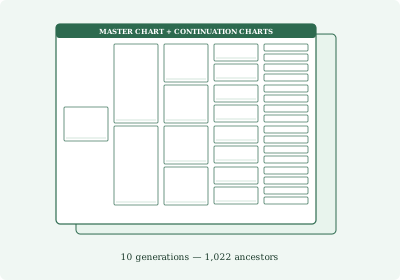
- Fill in the master chart — it is chart no. 1 — from yourself (left) through to your 16 great-great-grandparents in the right-hand column (generation 5).
- Give each of those 16 ancestors a chart number (2–17, top to bottom), and write it in their “Cont. chart no.” box.
- On the matching continuation chart, that ancestor becomes Person 1 — continue their line right, through to generation 10.
About This Template
Ten generations is 1,022 direct ancestors — 512 of them in the final generation alone. A single sheet can't hold that, so anyone offering a “one-page 10-generation chart” is really offering boxes too small to use. This pack takes the approach archives and family history societies have used for decades: a master chart records generations 1–5, and each of the sixteen ancestors in its right-hand column continues as Person 1 of their own numbered continuation chart, which carries that line from generation 5 to generation 10.
The practical beauty of the system is that it grows with your research. A line that hits a brick wall at generation 6 costs you nothing; a line that breaks through gets its own page with room for sources and dates. Generation 10 ancestors were mostly born in the 1600s and early 1700s — reachable through English parish registers (kept from 1538), Scottish old parish registers, European church books, and early colonial records in North America.
If ten generations is more than your research needs yet, the 6-generation chart or two-page 7-generation chart fit on far fewer sheets. If some of your lines run deeper still, the 15-generation chart pack extends the same numbering system by one more level.
Frequently Asked Questions
How many people does a 10-generation family tree show?
A complete 10-generation pedigree covers 1,022 direct ancestors, finishing with your 512 seventh-great-grandparents. This pack spreads them across a master chart and up to 16 numbered continuation charts so every box stays writable.
How does the continuation chart numbering work?
Each ancestor in the master chart's right-hand column gets a chart number; they then become Person 1 of the continuation chart with that number. Every continuation chart records which chart it continues from, so the set stays linked as it grows.
Can you realistically trace 10 generations?
Often yes, for at least some lines — generation 10 typically means ancestors born in the 1600s–1700s, within reach of parish registers. FamilySearch has free access to many. The pack format means you only print pages for the lines that keep going.