How to Use This Template
- Open the template in your browser using the button above.
- Print both pages in landscape orientation on A4 paper, or save as PDF.
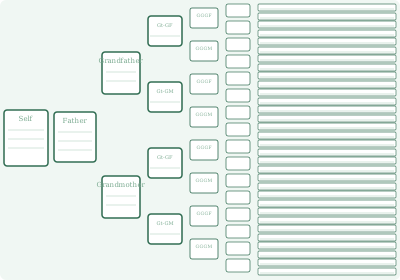
- Page 1 is your father's line: start with yourself on the left, then your father, and work right through each generation.
- Page 2 is your mother's line: fill in your details again, then trace your mother's ancestry the same way.
- The final column of each page holds 32 ancestors — your generation-7 great-great-great-great-grandparents. Fill them in as your research progresses.
About This Template
Seven generations is where single-page pedigree charts stop working. A full generation 7 contains 64 ancestors; squeezed into one A4 column, each box would be barely 3 mm tall. This template takes the approach working genealogists actually use: a bowtie split. Page one carries your father's ancestry and page two your mother's, so each page is effectively a 6-generation chart with you at its root — and every one of the 126 boxes stays writable.
Generation 7 ancestors were generally born between about 1770 and 1820. In Britain and Ireland that means parish registers rather than civil registration; in mainland Europe, church books and early civil records under Napoleonic administration. For Australian researchers this generation is often the immigrant generation — convicts arriving between 1788 and the 1850s, or assisted settlers of the 1830s and 1840s — making convict indents, shipping records, and colonial musters the key sources.
If your research has not yet filled a six-generation chart, start with the 6-generation pedigree chart and step up when the final column starts to fill. If you are pushing well past generation 7, the 10-generation chart pack uses numbered continuation charts to keep going.
Frequently Asked Questions
How many people does a 7-generation family tree show?
A full 7-generation pedigree covers 126 direct ancestors, finishing with your 64 great-great-great-great-grandparents. This template splits them across two pages — 63 ancestors per page — so every box stays writable.
Why is this template two pages instead of one?
A single-page 7-generation chart needs 64 boxes in its final column — about 3 mm per box on A4, too small to write a name. The two-page split halves that to 32 boxes per page, the same practical density as the 6-generation chart.
How far back does 7 generations reach?
Typically to ancestors born between 1770 and 1820. Parish registers are the main source for this era — FamilySearch has free access to many. For Australian lines, this is often the immigrant generation: convict indents, shipping lists, and colonial musters are the records to search.